
In what has proved to be one of the most controversial Romanian movies released this year, Alexandru Solomon, of Kapitalism – Our Secret Recipe (2010) fame, tackles the myth of Arsenie Boca, the modern day spiritual father of Romanian Orthodoxism. It’s all not clear cut of course, but that does not seem to be Solomon’s main concern here. Rather, he explores Arsenie’s instrumentalization in the present day, how this reflects on us as a people and how it is in itself an articulation of the waywardness of our society. It all works, but doesn’t reveal as much or hit as hard as it could have.
So who was Arsenie Boca? A priest, theologian, mystic and artist persecuted by the Romanian Communist Party, in part due to his supposed affiliations as a right-wing Legionary Movement. He died just before the 1989 Revolution. Today, Arsenie is seen as a symbol for Romanian Orthodoxism, somewhat begrudgingly by parts of the church (he was banned from monasticism in the mid 50s), with many people embarking on pilgrimages to his grave and hoping for his canonization as a saint.
An important disclaimer to start with: I am a mostly secular person, probably an agnostic, looking for faith in all the wrong places. I am also hard to shake when it comes to controversy, so the meek pressure groups that have tried and on occasion managed to disturb screenings of Arsenie meant little to me. For what it’s worth, they have most likely generated more interest in a movie…that is not brave enough to be truly controversial.
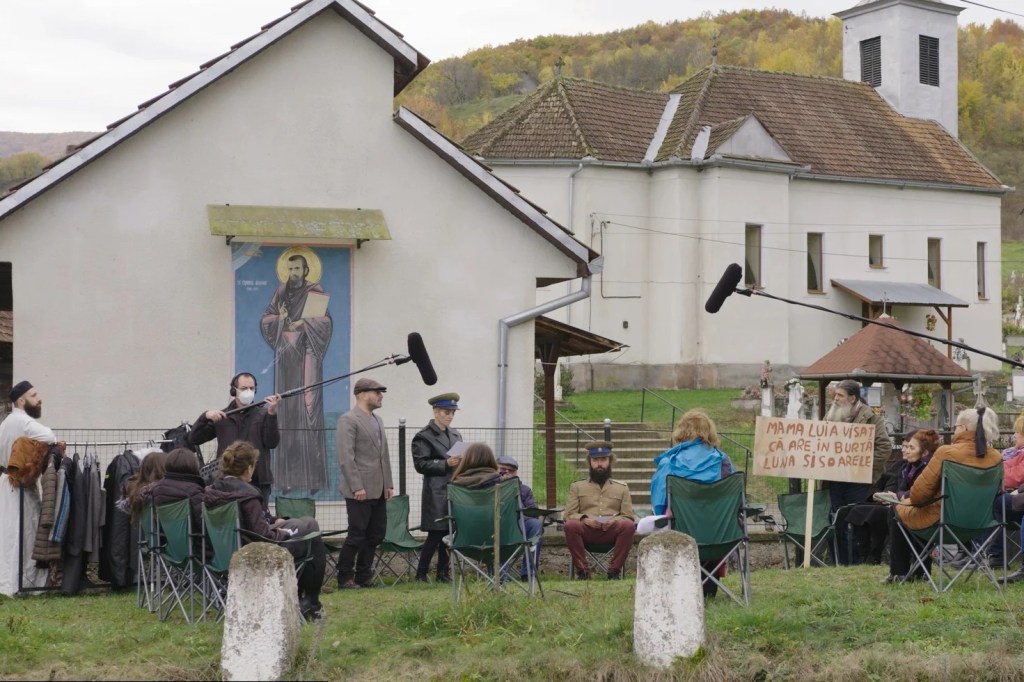
Solomon takes on the topic as a kind of meta-documentary. Doing a fly-on-the-wall documentary with people who pilgrimage to various holy(ish) sites related to Arsenie Boca proved less than viable, so instead he hired a group of people with some acting experience to go on this pilgrimage alongside him. From what I’ve understood, they are acting, reacting and reenacting, blurring the lines for the viewer’s perception. Solomon himself is a constant presence in front of the camera, providing input, comments and nudging conversation. Consequently, the reality and authenticity of this journey feels as constructed as the myth it is trying to explore.
By the end of it, you will not have learned much about Arsenie Boca. It is not clear to me what you will learn from the many protagonists, which include anything from skeptics to spiritualists. Solomon might claim he looks to be neutral, but there’s nothing neutral about his approach and what we are made to perceive has a satirical twang to it. The good part is that it’s all somewhat intriguing and there is a humor to it that can be enjoyed, even if it feels like we’re laughing at people, rather than with people – and their ambiguity made it difficult for me to enjoy that. There is an important truth to the observations Solomon makes, with Arsenie the most recognizable “brand” of the Romanian Orthodox Church, thanks in part to the industry it has forged around itself – to the point of Arsenie featuring in reality TV shows or his likeness being sold on magnets in supermarkets.
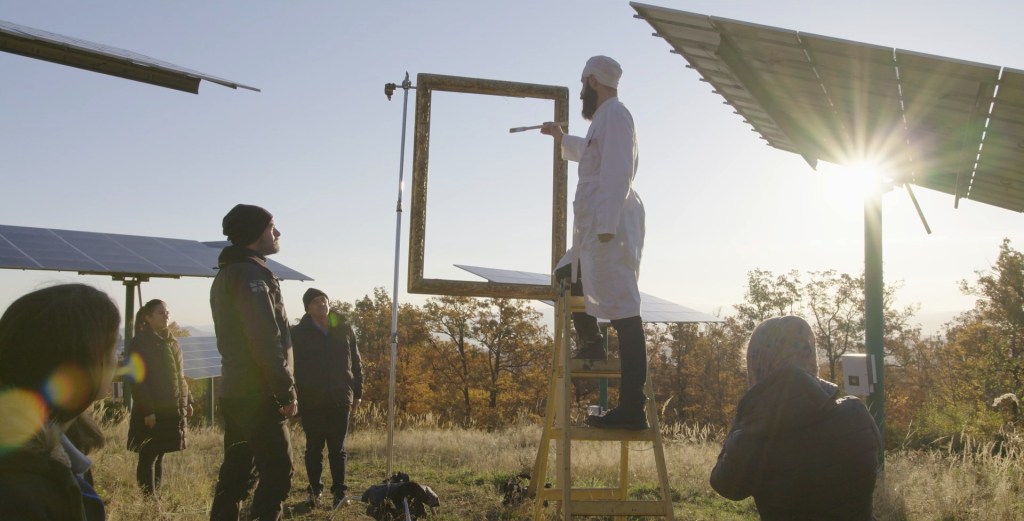
This is all interesting in a train-wreck kind of way to me, because I also perceive as part of our core dysfunctionality. However, it has next to nothing to do with spirituality and faith. It’s easy to dismiss it all as make-belief and dogma and a lot of the attitudes of religious institutions in Romania go some way towards enhancing this. But I feel there are important questions that each one of us can and should ask themselves and that the answer lies at the end of a life-changing exploration, whichever way it might conclude. Solomon’s film only prods at this very lightly, never really engaging. It functions as a curated frame, with some aesthetic to it and a valid cause, but that’s about it.
So what do we draw from Arsenie? It is the conclusion that we are lost, lost in our faith, but first and foremost lost in our culture and our society. The documentary is not an eminently spiritual piece of work, but that does not mean it should not have a spiritual core, something intrinsic to good filmmaking. What does Solomon make us care for here? Yes, we scorn the travesties of this click-baity world we live in, we should question it, but there has to be more to life than being angry. 6
 tributary stu