
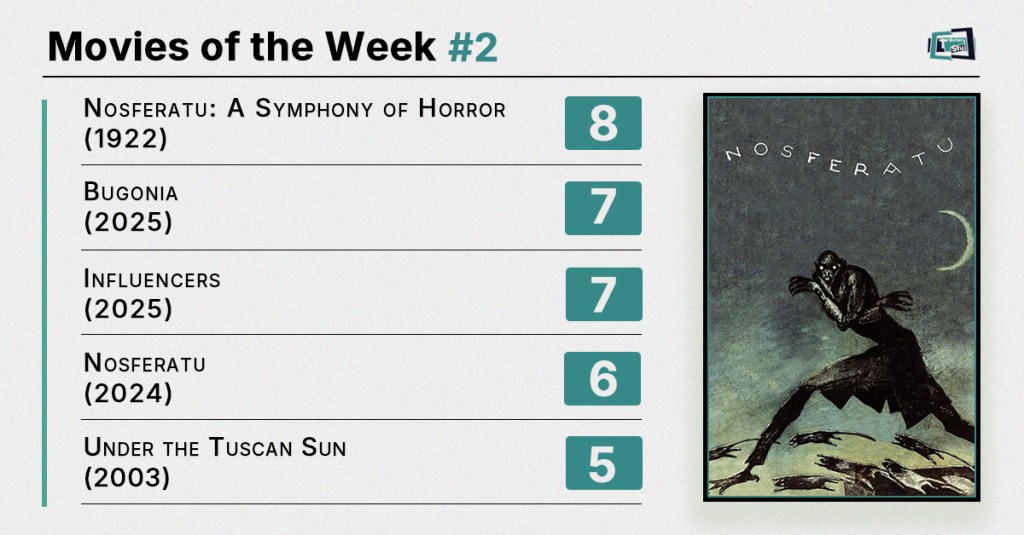
Nosferatu: A Symphony of Horror (1922): I hope to journey through some oldies this year, which I failed to do last time around. To start with, a classic that I’ve seen before, in preparation for the Eggers interpretation which is long overdue. The thing I love most about Murnau is, undoubtedly, his name. Friedrich Wilhelm. Can a name be more namey than this? It’s why I am too intimidated to watch any of Rainer Werner’s movies. Also, pretty obviously Murnau’s name is too cool to not be a pseudonym, which it is. I digress. Nosferatu is probably the first old movie and the first silent movie I ever saw – on purpose. I don’t recall if it was accompanied by an in-house concert, but in the several times I’ve seen it, there was one such occasion with live music. I reckon that’s the biggest draw for “modern” audiences when it comes to silent movies, even if the scope of the music is usually much reduced from what was going on back in the day. Not quite the amplitude of a horror symphony. Most people know the story of Nosferatu, the Transylvanian vampire who brings death with him wherever he goes. Whether this is a reference to the political climate after the first World War or just an artistic exploration of Murnau’s is still a topic of conversation. Regardless, what stood out to me was the set of on-location shots, which make the movie feel a lot more real than many of its contemporaries. The distinctive lighting, which emphasizes the impact of expressionistic art on Murnau’s visuals, goes a long way to create striking and memorable scenes. As I’ve probably said before, watching silent movies with a present-day frame of mind takes some getting used to, but as the syntax of early 20th century films becomes more apparent, so does the appreciation of what filmmakers like Murnau were trying to achieve. 8
Bugonia (2025): It feels to me like Lanthimos has quickly become, due to his increased output, fairly derivative. In Bugonia he explores themes of conspiracy and benevolent corporatocracies, in a movie that has an undercurrent of Good Time (2017). That’s probably because of the two bumbling “anarchists”, played by Jesse Plemons and Aidan Delbis, who decide to kidnap a big-company CEO, Emma Stone, because she’s…an alien enslaving humanity. And it’s all because of the bees. The set-up sounds amusing on paper and it does play out in an entertaining fashion for the most part. But by the end it feels more like a satirical pamphlet than something that has actual artistic or socio-political weight to it. 7
Influencers (2025): Following-up on the 2022 film, this plays out like a cool, moody extension to the original. I called it slick and sexy last time around, and that still stands. Our likable antagonist survived the drama and is up to no good again, triggered by self-absorbed influencers like some are by narco-terrorists. I think the movie is more focused, taking a principled stance on the “influencer problem”, which has become more fleshed out in the past few years, as the manosphere has grown. It’s not to be taken too seriously, otherwise the tricks of CW would be grating to the reality-bound among us, but it doesn’t indulge in too much tomfoolery. I think the movie’s main problem is that you cannot root for the haunted, victimised protagonist and, once more, the twists toward the end were annoying. Influencers does go out on a high-note though, in preparation for what I expect to be a relentless finale of the (presumed) trilogy. 7
Nosferatu (2024): I just had to compare, right? Not that it would be fair to do so. They might both be movies, but what they represent and the way in which they are made is fundamentally different. Problem is, I’m not totally sure what Eggers is trying to prove with his adaptation. He focuses on Ellen and ties her story into Nosferatu’s in a manner that’s more easily readable for a modern audience. It’s too bad that this isn’t really a two hour + kind of story, and it’s particularly the first part of the journey that plays like a tame retelling of the original. A tighter film, truly dedicated to Ellen, would have yielded a better experience. I can’t say I much liked what Lily-Rose Depp and Nicholas Hoult brought to their characters, but everything lights up once Willem Defoe is on the screen. The somber spectacle that Eggers goes for has a dark beauty to it at times, yet fails to coherently engage on an emotional level with any of its protagonists. 6
Under the Tuscan Sun (2003): I kept waiting to see if there’s anything more to this Diane Lane led movie about a divorcee who impulsively buys a run-down villa in Tuscany. There isn’t. It’s all very modest in terms of ambitions, the kind of flick that you can easily identify, just like the food-porn movies and the torture-porn movies, this one on the Eat, Pray, Love tourism spectrum (but predating said monument of cultural grit). Which is not to say that it isn’t pretty to look at, even if the characters do have to do some driving around to hit the landmarks. It’s a shame that Lane’s talents aren’t put to better use, as she’s surrounded by forgettable subplots and lackluster performances. Not a movie to make you upset, but not much else either. 5
 tributary stu